B2B vs B2C SaaS SEO: Key Differences & Winning Strategies
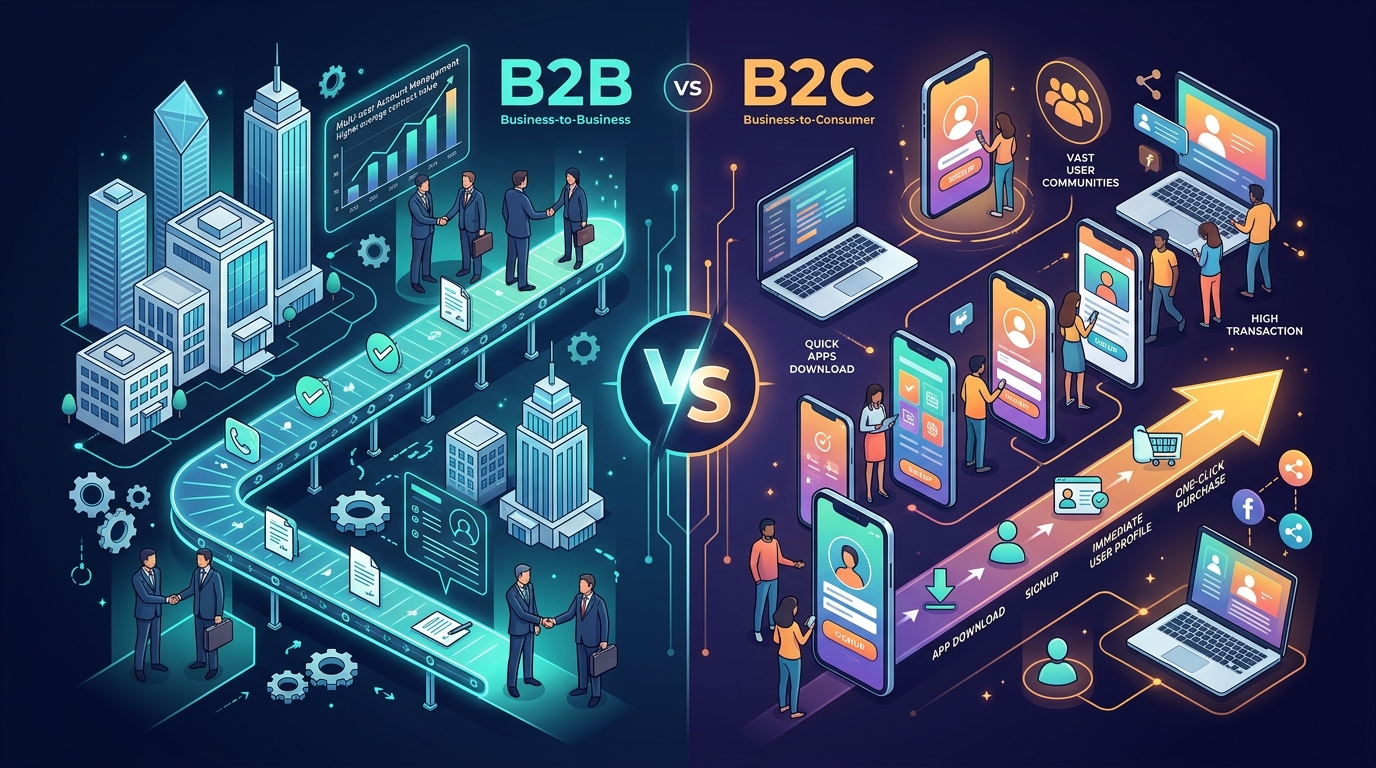
Optimizing a SaaS product for search engines isn't a one-size-fits-all endeavor. The tactics that propel a consumer app to the top of Google will often fall flat for an enterprise software platform, and understanding the nuances of B2B vs B2C SaaS SEO is crucial for sustainable, profitable growth.
Understanding B2B vs B2C SaaS Business Models
Before diving into specific SEO tactics, it is critical to recognize the foundational differences between Business-to-Business (B2B) and Business-to-Consumer (B2C) SaaS models. The way your audience searches, evaluates, and ultimately purchases software dictates how you structure your entire organic strategy.
In the B2C SaaS space, the buying process is generally straightforward. Think of apps like Spotify, Duolingo, or simple budget trackers. The user is a single individual making a fast, emotionally-driven, or utility-driven decision. The Annual Contract Value (ACV) is low, often ranging from $50 to $200 per year. The sales cycle takes minutes, and users usually convert via a seamless freemium model or a frictionless free trial.
Conversely, B2B SaaS operates in a completely different ecosystem. You are selling to organizations, which means navigating multiple stakeholders—the end-user who needs the tool, the IT director who evaluates security, and the CFO who signs the check. Because of this complexity, the B2B sales cycle spans weeks or even months. The ACV can range from thousands to hundreds of thousands of dollars.
This means your B2B SaaS SEO efforts must cater to a longer, non-linear journey. You are not just trying to get a quick sign-up; you are trying to educate, build immense trust, and seamlessly transition an organic visitor into a Sales Qualified Lead (SQL).
Keyword Strategy Differences
The discrepancy in buyer psychology between business and consumer audiences requires two radically different approaches to keyword research and targeting.
For B2C SaaS, keyword strategy is dominated by high-volume, problem-focused queries. Consumers search using everyday language and broad terms. A consumer looking for a graphic design tool might search for "how to make a birthday flyer" or "free photo editing app." The search volumes are massive, often reaching tens or hundreds of thousands of queries per month. The goal here is capturing maximum top-of-funnel traffic and relying on a highly optimized product UI to convert those casual browsers into users.
B2B SaaS SEO keyword strategy, however, is an exercise in precision over volume. Business buyers use specific, technical jargon and search with high commercial intent. An enterprise organization does not search for "how to manage work." They search for "SOC2 compliant enterprise resource planning software for healthcare," or "Salesforce vs Hubspot CRM migration."
When mapping B2B keywords, you must prioritize intent and relevance. A keyword with a search volume of 50 per month is incredibly valuable if those 50 searchers are CTOs with six-figure budgets. You must aggressively target modifier keywords such as "enterprise," "platform," "software," "solutions," and "alternatives."
Content Strategy: Authority vs Virality
Content is the vehicle that carries your SEO strategy, but the payload looks very different depending on who is in the driver's seat. B2C content thrives on virality, entertainment, and immediate utility. B2B content must exude authority, logic, and proven ROI.
B2C SaaS brands succeed with content that is easily digestible and highly shareable. Think listicles ("10 Best Budgeting Apps for College Students"), quick video tutorials, interactive quizzes, and community-driven forums. The goal is to reduce friction and create an emotional connection with the user.
In B2B, emotional appeals are secondary to logical justifications. The content must equip a champion within the target company with the data they need to convince their boss to buy your software. This requires investing heavily in long-form, authoritative assets. You need detailed whitepapers, data-driven industry reports, comprehensive case studies demonstrating undeniable ROI, and deeply technical product documentation.
To master this, you need a cohesive SaaS SEO strategy guide that maps specific content formats to the complex B2B buyer journey. Mid-funnel content—like integration guides and detailed feature comparisons—becomes critical for nurturing leads who are evaluating multiple enterprise platforms simultaneously.
Link Building: B2B vs B2C Approaches
Backlinks remain a fundamental pillar of Google's algorithm, but the methods used to acquire them diverge significantly between business and consumer models. Your link acquisition strategy must align with where your audience congregates online.
B2C SaaS companies can often leverage the broader internet culture. They succeed with PR campaigns that target mainstream media, influencer partnerships, viral infographics, and lifestyle bloggers. A consumer app might build hundreds of links by releasing a fun, interactive data visualization that appeals to a wide demographic.
Link building in the B2B space is much more targeted and requires a higher degree of finesse. You are aiming for placements on industry-specific publications, authoritative business blogs, and specialized resource pages. Tactics that work exceptionally well for B2B include:
- Original Data Studies: Surveying your industry and publishing proprietary data that other businesses and journalists will naturally cite.
- Expert Roundups and Podcasts: Getting your founders featured on industry podcasts and B2B media outlets.
- Integration Partnerships: Earning high-authority links from the partner directories of other SaaS companies you integrate with (e.g., Shopify, Slack, or Salesforce).
To scale these efforts effectively without resorting to spam, review our comprehensive link building services designed specifically for the rigorous quality standards of the B2B software industry.
Technical SEO Considerations
While the fundamentals of Technical SEO—crawlability, indexability, and clean code—apply universally, the specific technical challenges differ vastly between consumer and enterprise platforms.
B2C SaaS websites must be hyper-optimized for mobile. Consumers often search for, evaluate, and even download consumer apps directly from their smartphones. Therefore, extreme page speed, flawless mobile responsiveness, and strict adherence to Google's Core Web Vitals are absolutely non-negotiable. If your page takes three seconds to load on a 4G connection, you have already lost the consumer.
On the B2B side, traffic is predominantly desktop-based, as research is done during working hours on office machines. While speed still matters, the technical complexities usually stem from site architecture. Enterprise SaaS websites are massive. They feature dozens of product pages, complex feature matrices, extensive resource libraries, and deep integration directories.
A primary challenge in B2B technical SEO is handling gated content. You have high-value assets like whitepapers and webinars hidden behind lead capture forms. You must ensure that Google can crawl the "teaser" content or the landing page effectively to rank the asset without giving away the gated payload. Furthermore, many B2B SaaS sites use complex JavaScript frameworks (React, Angular) for their marketing sites, requiring specialized technical SEO services to ensure search engines can properly render and index the content.
Conversion Path Differences
Driving organic traffic is only half the battle; how you convert that traffic defines the success of your SEO program. The conversion UI and the desired user actions are vastly different for B2B and B2C.
For a B2C SaaS product, the organic conversion path must be frictionless. The primary Call to Action (CTA) is almost always "Start Free Trial," "Sign Up with Google," or "Download App." There are no barriers, no mandatory credit card fields, and no sales calls. SEO success relies heavily on getting the user straight into the product UI as fast as humanly possible to experience the "Aha!" moment.
B2B conversions require much more orchestration. Because the software is expensive and implementation is complex, users rarely buy on their first visit. Instead, you are optimizing for macro and micro-conversions. The ultimate macro-conversion is a "Request Demo" or "Talk to Sales" submission. However, a massive portion of your organic traffic isn't ready for a demo.
Therefore, B2B SaaS SEO must seamlessly integrate lead magnets. You capture an email address in exchange for an industry report, pushing the user into a marketing automation sequence. The conversion path is layered: from organic search, to blog post, to gated content download, to email nurture sequence, and finally, to a booked sales meeting.
Measuring SEO Success: B2B vs B2C Metrics
If you measure a B2B SaaS SEO campaign using B2C metrics, you will completely misunderstand the value being generated. You must align your KPIs with your specific business model.
In B2C, success looks like a hockey-stick graph of traffic and signups. Key metrics include total organic sessions, new user registrations, Free-to-Paid conversion rates, and the Average Revenue Per User (ARPU) associated with organic cohorts. Volume is the name of the game.
In B2B, high traffic volume is often a vanity metric. If a blog post gets 10,000 visits but zero demo requests, it is failing. B2B SEO success is measured by pipeline contribution. You need to track:
- Marketing Qualified Leads (MQLs): How many relevant emails did organic traffic capture?
- Sales Qualified Leads (SQLs): How many of those leads actually booked a qualified demo?
- Pipeline Value: What is the total potential dollar value of the deals generated by organic search?
- Customer Acquisition Cost (CAC): How much are you spending on SEO relative to the enterprise deals you are closing?
To ensure your tracking is set up correctly and your metrics align with revenue goals, it is highly recommended to start with a comprehensive free SEO audit to identify tracking gaps and pipeline bottlenecks.
Hybrid SaaS: When You Serve Both B2B and B2C
What happens when your software serves both audiences? Companies like Canva, Slack, and Zoom have famously navigated the hybrid model—offering a free/low-cost consumer version alongside a heavy-duty enterprise tier. This presents a unique set of SEO challenges.
The biggest risk in a hybrid model is keyword cannibalization and mixed intent. If your homepage tries to speak to a college student looking for a free design tool *and* a Fortune 500 CMO looking for brand management software, it will resonate with neither.
The winning strategy is aggressive content segmentation and intelligent site architecture. Typically, the main domain and top-level navigation cater to the high-volume B2C/freemium audience to capture market share and drive product-led growth (PLG). Simultaneously, a dedicated subfolder (e.g., yourdomain.com/enterprise/) or specific solution pages are built explicitly for the B2B buyer.
These B2B-specific pages utilize entirely different keywords, feature corporate branding, showcase enterprise case studies, and replace "Sign Up Free" CTAs with "Contact Sales." By cleanly separating the user journeys, search engines can accurately route consumer queries to your product pages and commercial queries to your enterprise solutions.
Frequently Asked Questions
Is SEO more effective for B2B or B2C SaaS companies?
SEO is highly effective for both, but the impact is measured differently. B2B SEO drives high-ticket, low-volume conversions resulting in massive pipeline value. B2C SEO drives high-volume, low-friction signups, leading to rapid user base growth and scalable freemium conversions. Both models absolutely require SEO to achieve sustainable growth.
How do keyword volumes differ between B2B and B2C SaaS?
B2C keywords typically boast massive search volumes (thousands of searches per month) because they target broad consumer problems. In contrast, B2B keywords are highly niche and technically specific, often showing less than 100 searches per month. However, the intent and lifetime value of B2B keywords are significantly higher.
Should B2B and B2C SaaS companies use different SEO tools?
While foundational tools like Ahrefs, SEMrush, and Google Search Console are essential for both, B2B SaaS companies often rely more heavily on tools that integrate with their CRM (like HubSpot or Salesforce) to track pipeline velocity. B2C companies might heavily utilize product analytics tools like Amplitude or Mixpanel alongside traditional SEO software.