On-Page SEO Checklist for SaaS Websites: 25+ Steps
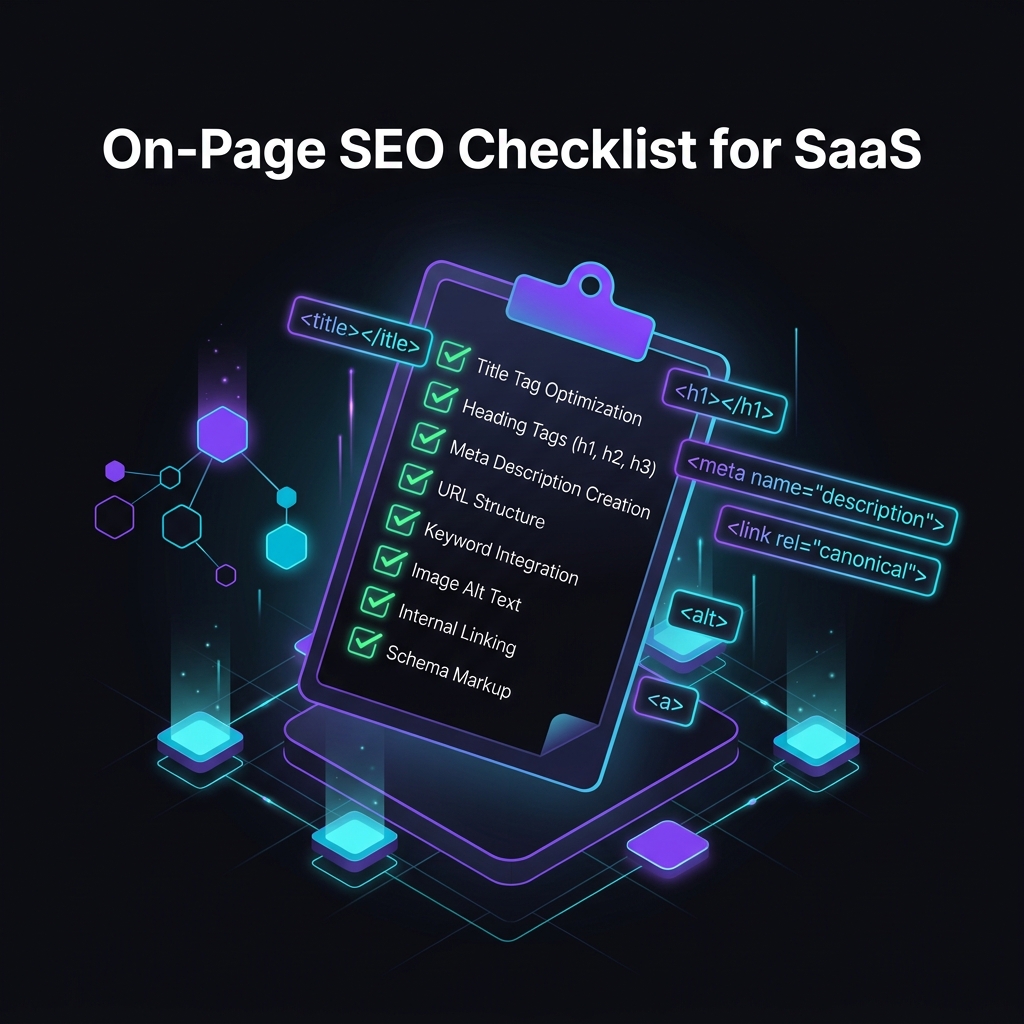
SaaS on-page SEO requires a specialized execution framework. Unlike standard e-commerce or local business websites, software platforms must rank for high-intent commercial keywords, technical problem-solving queries, and competitive product comparison searches while delivering high trial and demo conversion rates.
Phase 1: Meta Data & SERP Snippet Optimization
Your search snippet is your organic digital storefront. Optimizing meta tags directly impacts click-through rate (CTR) and initial search engine relevance signals.
1. High-Intent Meta Title Tags
Keep titles under 60 characters to prevent truncation in Google SERPs. Place primary target keywords (e.g., "SaaS On-Page SEO") near the front of the tag. Test snippet character length using our free meta title and description checker.
2. High-CTR Meta Descriptions
Write compelling 140–155 character descriptions featuring clear value propositions and action-oriented calls-to-action (CTAs). Preview how your listing appears across mobile and desktop devices with our Google SERP preview tool.
3. Clean, Human-Readable Permalinks
Ensure URLs are short, lowercase, and hyphen-separated (e.g., /blog/on-page-seo-checklist-saas.html). Avoid dynamic query parameters or dates in category paths.
4. Self-Referential Canonical Tags
Prevent duplicate content issues caused by tracking parameters (e.g., ?utm_source) by implementing self-referential canonical tags on every page. Generate precise canonical tags using our canonical tag generator.
5. Open Graph & Social Cards
Ensure social platforms (LinkedIn, Twitter, Facebook) render rich visual cards when your content is shared by adding og:title, og:description, and og:image. Validate tag syntax with our Open Graph tag generator.
Phase 2: Heading Architecture & Content Depth
Search engines and human readers demand clear document hierarchy and comprehensive topical depth to establish E-E-A-T (Experience, Expertise, Authoritativeness, and Trustworthiness).
6. Single H1 Tag Hierarchy
Every landing page and article must contain exactly one primary <h1> element aligned with the primary target keyword. Audit your heading hierarchy with our heading tag analyzer.
7. Logical H2–H4 Subheading Structure
Break complex technical topics into scannable sub-sections using H2 and H3 tags. Use descriptive subheadings that answer secondary search queries.
8. Natural Keyword Density & LSI Entities
Maintain a natural keyword density between 1.0% and 2.0%. Avoid keyword stuffing, which triggers search spam penalties. Verify word count and phrase distribution using our keyword density checker and word counter tool.
9. Answer-First Snippet Formatting
Format definition sentences and summary paragraphs directly under H2 headers in 40–50 words to win Google Featured Snippets and AI Overview citations (AEO).
10. Search Intent Alignment (ToFU, MoFU, BoFU)
Match content tone to the buyer journey stage. Educational queries require unbiased tutorials, while bottom-of-funnel (BoFU) pages require feature comparisons, pricing clarity, and social proof.
Phase 3: SaaS Internal Linking & Pillar Mesh
Internal links distribute link equity across your domain and guide crawlers toward high-converting product pages.
11. Contextual Anchor Text Interlinking
Link relevant blog concepts directly to commercial service offerings using descriptive, keyword-rich anchor text. For example, explore our specialized on-page SEO services.
12. Topic Cluster & Pillar Page Architecture
Connect supporting cluster articles back to comprehensive cornerstone guides. Review our master framework in The Complete SaaS SEO Strategy Guide.
13. Breadcrumb Navigation Trails
Implement structured breadcrumb paths (Home › Blog › Category) with Schema markup to improve site navigation and crawl efficiency.
14. Regular Link Audit & 404 Resolution
Audit site architecture quarterly to eliminate broken internal links and redirect orphan pages to relevant active URLs.
Phase 4: Structured Data & Schema Markup
Structured data provides explicit search engine context, enabling rich snippet badges that boost organic click-through rates.
15. SoftwareApplication Schema for Product Pages
Annotate SaaS product feature pages with SoftwareApplication JSON-LD to display pricing tiers, operating systems, and application categories in SERPs.
16. Article & BlogPosting Schema
Embed rich Article markup on editorial posts to convey author credentials, publication dates, and publisher logo metadata. Generate schema templates with our schema markup generator.
17. FAQPage Structured Data
Add FAQPage schema to product landing pages and guides to secure multi-accordion rich results directly in Google search listings.
18. E-E-A-T Person & Organization Links
Link author fields to dedicated bio pages and active LinkedIn profiles using sameAs attributes to satisfy Google Search Quality Rater Guidelines.
Phase 5: Technical Media & Core Web Vitals
User experience and technical page performance are direct Google ranking factors.
19. WebP / AVIF Image Compression
Convert heavy PNG/JPG product screenshots into modern WebP or AVIF formats to reduce payload sizes by up to 70%.
20. Explicit Width and Height Attributes
Prevent Cumulative Layout Shift (CLS) layout jumps by specifying explicit width and height dimensions on all <img> tags.
21. Core Web Vitals Performance Targets
Optimize JavaScript rendering and CSS execution to achieve Largest Contentful Paint (LCP) < 2.5s and Interaction to Next Paint (INP) < 200ms.
Phase 6: Conversion Rate Optimization (CRO)
Organic traffic is vanity; qualified SaaS conversions are sanity. On-page SEO must work hand-in-hand with conversion optimization.
22. Above-the-Fold Value Proposition & CTA
Display your product headline and primary call-to-action (Free Trial / Book Demo button) immediately within the initial viewport.
23. Embedded Interactive Tools & Widgets
Boost dwell time and user engagement by embedding helpful calculators, SERP previews, or interactive checklists within blog posts.
24. High-Scannability Formatting
Utilize bulleted lists, key takeaway callout boxes, bold lead-ins, and short paragraphs to maximize reader retention.
25. Mobile-First Touch Targets
Ensure button sizes maintain a minimum height of 48px with adequate padding for seamless mobile navigation.
Frequently Asked Questions
What makes SaaS On-Page SEO different from traditional SEO?
SaaS SEO focuses on multi-touch buyer journeys across ToFU educational queries, MoFU comparison terms, and BoFU high-intent keywords. Unlike e-commerce, SaaS on-page optimization must balance technical positioning with trial/demo conversion paths.
Which on-page factor has the biggest impact on SaaS search rankings?
Matching Search Intent combined with comprehensive Topical Authority delivers the highest ranking impact. Crafting exact answers that solve user pain points while structuring proper H1-H3 document hierarchy signals immediate relevance to search engines.
How often should SaaS companies update their on-page content?
Core feature and landing pages should be audited quarterly. Blog posts and comparison guides should be updated every 6 months to refresh statistics, add new product features, and maintain search freshness signals.