Meta Title Length Guide for SEO and Search Results
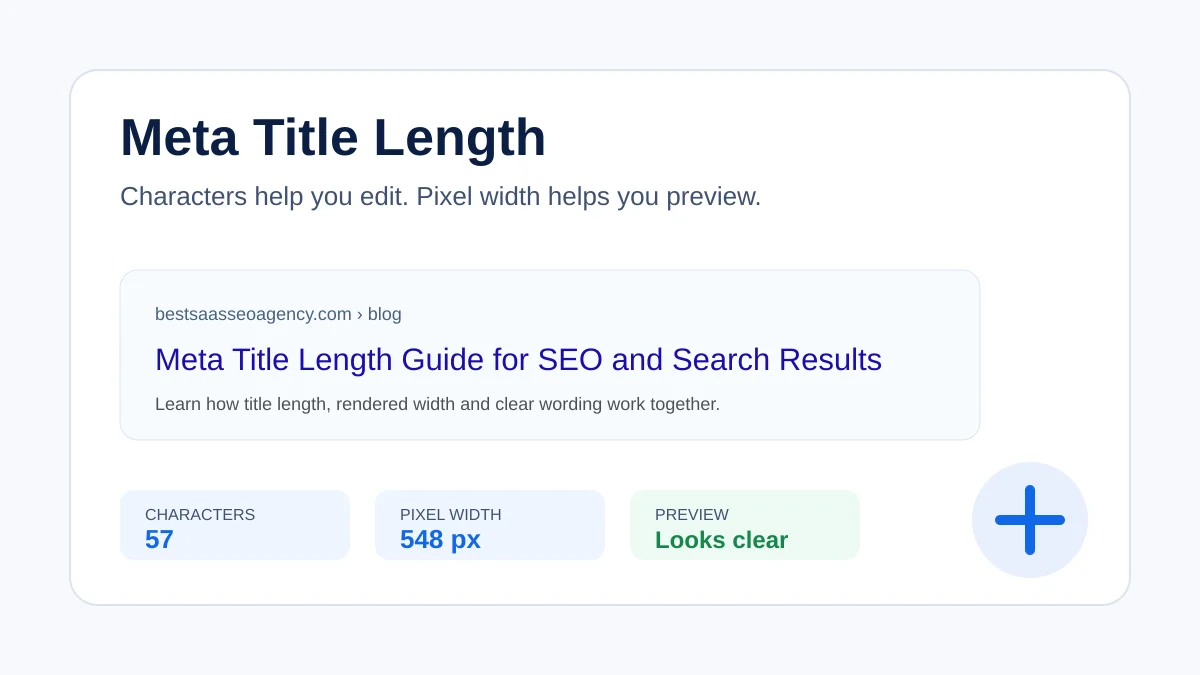
A useful meta title is long enough to explain the page and short enough to stay easy to scan. There is no single character count that guarantees how a title will appear in Google. Search results are rendered visually, letters take different amounts of space, devices vary, and Google can generate a different title link when it believes another version is more helpful.
For day to day SEO work, a title around 50 to 60 characters is a practical writing range, not a rule. The better check is whether the wording communicates the page clearly and whether its estimated pixel width fits the search preview. If you are new to the concept, read our guide to what a meta title is first.
How Long Should a Meta Title Be?
There is no official Google meta title character limit that every page must follow. Google recommends descriptive and concise title text and can truncate or change what appears as a title link. This means a 58 character title can still look wider than another title with more characters because a word full of wide letters uses more visual space.
A practical workflow is to draft the clearest title first, then check its visual width. If the important idea is buried at the end, move it earlier. If the title feels vague simply because you tried to make it short, add enough context to make the result understandable. The goal is not to win a character counting contest. The goal is to help the right searcher recognize the page.
Meta Title Characters and Pixel Width Are Different
Character count is convenient because every editor can measure it, but search results are not laid out in equal width character boxes. A capital W is much wider than a lowercase i. Brand names, numbers, punctuation and capitalization can therefore change the space a title occupies even when the character count stays the same.
This is why our Meta Title and Description Checker measures both characters and estimated rendered width. It also lets you switch between desktop and mobile previews. The preview is still an estimate because Google controls the final presentation, but it gives you more useful information than a character count alone.
A Simple Meta Title Length Example
Imagine a page called Meta Title and Description Checker for SEO Professionals and Website Owners. It describes the page, but the important tool name competes with extra wording. A cleaner version such as Meta Title and Description Checker communicates the purpose immediately. If branding is useful, it can be added only when there is enough room and it helps the searcher identify the source.
Now consider a different page called SEO Guide. That title is short, but short does not automatically mean good. It gives almost no clue about the subject. A title such as Meta Title Length Guide for SEO is more specific even though it uses more characters. Relevance and clarity come before hitting a particular number.
What Happens When a Meta Title Is Too Long?
A long title may be visually truncated in a search result, which can hide words near the end. That does not mean the page receives a direct penalty because the title crossed a particular character threshold. The practical problem is communication. If the differentiator, product name or key context disappears from view, a searcher may understand less about the result.
Truncation is also not the same as a Google title rewrite. A title can be shortened visually, while a title link can also be generated from other page signals. Google documents that title links can draw from the title element, visible page title, headings and other prominent text. Keeping these elements aligned gives search systems clearer information about the page. We will cover the reasons Google rewrites title tags in a dedicated cluster guide later.
Can a Meta Title Be Too Short?
Yes, in the sense that it can fail to communicate enough information. A title such as Pricing, Tools or Guide may make sense inside a website navigation, but a person seeing the page for the first time in search may need more context. A concise title should still identify the topic or purpose of the page.
Do not add filler simply to make the count larger. A short title that fully describes a narrowly focused page can be perfectly useful. Length is a diagnostic signal, not a target that must be filled.
Where Should the Main Topic Appear in the Title?
Put the most useful identifying information where a person can notice it quickly. For many pages this means placing the primary topic near the beginning, but natural wording matters more than forcing an exact match phrase into the first few words. A title should read like a real label for the page rather than a string of search terms.
For this article, the phrase meta title length appears early because it accurately describes the subject. We do not need to repeat variations such as SEO title length and title tag length several times in the same title. Related language can appear naturally in the article where it helps explain the topic.
Does Meta Title Length Change on Mobile?
Search layouts differ across devices and can change over time, so it is better to review both desktop and mobile presentations than assume one fixed width applies everywhere. The same title may wrap, truncate or be displayed differently depending on the search interface.
Our checker includes separate desktop and mobile preview modes for this reason. Use them to spot obvious presentation problems, then judge the title as a piece of copy. A title that remains clear even if the final words are not shown is usually more resilient than one that saves the most important information for the end.
How to Check Meta Title Length Before Publishing
Write the title around the page intent first. Read it without looking at your keyword list and ask whether a new visitor could predict what the page contains. Then paste it into the free meta title checker and review the character count, estimated pixel width and search preview. If you have a target query, use the query alignment check to see whether the important concepts are represented without stuffing them into the title.
Finally, compare the title with the H1. They do not need to be identical, but they should describe the same page. After publication, monitor Search Console rather than repeatedly changing a title based only on a preview. Real impressions and queries can show whether Google understands the page and which searches are actually surfacing it.
Common Questions About Meta Title Length
Is 60 characters the maximum meta title length?
No. Sixty characters is commonly used as a practical editing reference, not an official maximum that guarantees display. Visual width and the search interface matter, and Google can generate a different title link.
Does a long title hurt SEO?
A title is not automatically bad because it exceeds a particular character count. A title becomes less useful when it is repetitive, vague, stuffed with keywords or difficult for searchers to understand. Excess length can also hide useful words in the visible result.
Should I count spaces in a meta title?
Character counters normally include spaces, but pixel measurement is more useful for estimating visual fit because individual characters and spaces do not all occupy the same width.
Should the brand name be in every title?
Not necessarily. Branding can be helpful when recognition matters, but it should not crowd out the information that identifies the page. Use it when it improves the title for the searcher.
Final Thoughts
Meta title length is best treated as a usability check rather than a rigid SEO rule. Start with an accurate title, keep the important idea easy to find, remove repetition and then review how much visual space the wording uses. Character count can help you edit, while pixel width gives a better estimate of how the title may fit.
If you are working on a title now, run it through our Meta Title and Description Checker. The tool can compare variants, estimate rendered width and show desktop and mobile previews before you update the live page.
Sources and Further Reading
For primary search guidance, read Google Search Central guidance on title links. It explains how title links are generated and recommends descriptive, concise title text without keyword stuffing or repeated boilerplate.