SaaS Landing Page SEO: How to Optimize Feature & Pricing Pages
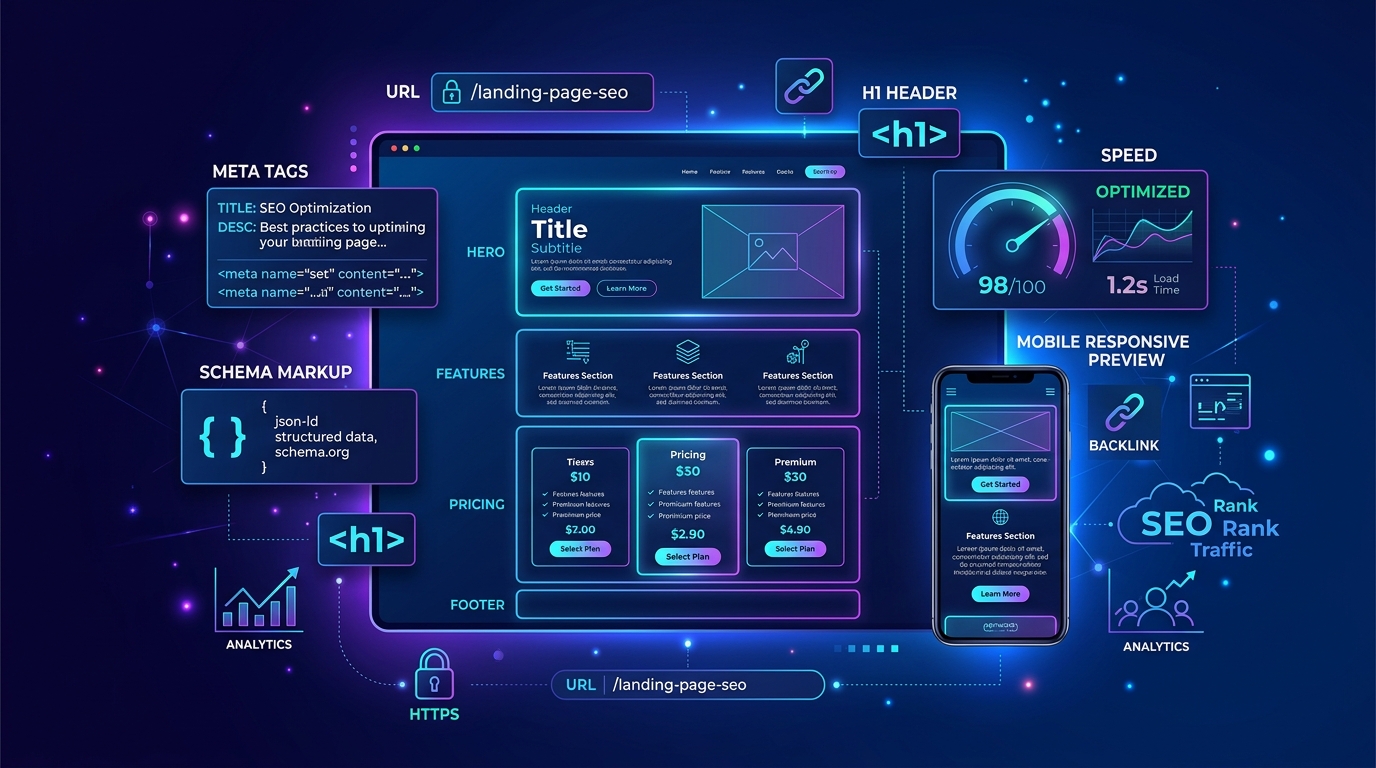
SaaS landing pages are the critical juncture where organic traffic transforms into paying customers. Mastering SaaS landing page SEO ensures that these high-stakes pages not only rank for valuable commercial queries but also deliver an experience optimized for conversion.
Why SaaS Landing Pages Need a Different SEO Approach
Treating your SaaS landing pages like standard blog posts is a recipe for missed revenue. A blog post is typically designed to educate, inform, and satisfy informational intent. A SaaS landing page, however, exists to convert. This fundamental difference means your SEO strategy must pivot significantly when optimizing product, feature, and pricing pages.
The primary challenge with SaaS landing page SEO is balancing conversion rate optimization (CRO) with search engine crawlability. Marketers often want landing pages that are visually stunning, which leads to heavy reliance on JavaScript frameworks, interactive elements, and minimal text. However, search engines still rely heavily on text to understand context and relevance.
Here are the core reasons why a distinct approach is required:
- JavaScript Rendering Challenges: Many SaaS product pages are built using dynamic JS frameworks (React, Vue, Angular). If server-side rendering (SSR) or dynamic rendering isn't configured correctly, Googlebot might see a blank page, rendering your SEO efforts useless.
- Thin Content Risks: The desire for a "clean, minimalist" design often results in pages with fewer than 300 words. Search engines struggle to rank thin content for competitive commercial keywords because they lack sufficient context to determine relevance and authority.
- Commercial Intent Match: Landing page keywords are highly commercial (e.g., "workflow automation software"). Users searching these terms aren't looking for a definition; they want a solution. Your content must immediately demonstrate product capabilities, trust, and pricing clarity.
To succeed, you must design landing pages that feed search engines the structural and contextual data they crave without compromising the user journey. It is a delicate dance between persuasive copywriting and technical SEO excellence.
Feature Page SEO: Ranking for Solution-Aware Queries
Instead of cramming every capability onto a single "Features" page, successful SaaS companies build individual pages for each core feature. This strategy allows you to target specific, high-intent solution-aware queries. When a prospect searches for "automated invoice processing tool," a dedicated feature page will always outperform a generic homepage.
To optimize individual feature pages (e.g., /features/workflow-automation), you must structure them meticulously. Start with a crystal-clear H1 tag that aligns perfectly with the target keyword and the user's search intent. For example, instead of a vague H1 like "Work Smarter," use "Workflow Automation Software for Marketing Teams."
Beyond the H1, here is how to dominate feature page SEO:
- Semantic Structure: Use H2s and H3s to break down the feature's specific capabilities. This not only makes the page scannable for users but also helps search engines understand the topical breadth of the page.
- Unique Value Propositions (UVPs): Do not just list features; articulate the benefits. Explain how the feature solves a painful problem. Search engines are increasingly good at parsing semantic meaning and rewarding comprehensive answers.
- Schema Implementation: Deploy
SoftwareApplicationandProductschema on these pages. While often reserved for the homepage, applying structured data to specific feature pages helps Google understand that this page represents a distinct capability of your software suite.
Furthermore, combat thin content by providing detailed use cases. Explain how different industries or roles utilize the feature. This naturally introduces secondary keywords and LSI (Latent Semantic Indexing) terms, enriching the page's topical relevance without keyword stuffing.
Pricing Page Optimization
Your pricing page is arguably the most important bottom-of-funnel asset on your entire website. Prospects landing here are on the verge of making a purchasing decision. Yet, many SaaS companies neglect pricing page SEO, assuming it's purely a conversion mechanism. This is a critical error.
Users actively search for pricing information. Queries like "[Your Brand] pricing" or "How much does [Competitor] cost" have immense search volume. If you don't own these SERPs, third-party review sites like G2 or Capterra will, effectively stealing your direct traffic and controlling the narrative around your value.
To optimize your pricing page, you must implement specific technical and content strategies:
- SoftwareApplication Schema: This is non-negotiable. You must implement
SoftwareApplicationstructured data, explicitly defining theoffersproperty. This allows Google to potentially display rich snippets showing your price range directly in the search results, dramatically improving Click-Through Rate (CTR). - Comprehensive Comparison Tables: Don't just list tiers (Basic, Pro, Enterprise). Include detailed, HTML-based comparison tables. Search engines can parse these tables easily, and they often get pulled into Featured Snippets for comparison queries. Ensure the text within the tables is actual HTML, not an image.
- Addressing Objection Keywords: Include an FAQ section at the bottom of the pricing page. Target long-tail, objection-based queries such as "Are there hidden fees?", "Do you offer a money-back guarantee?", or "Is there a discount for annual billing?". This adds valuable, semantically relevant content to a page that is typically visually heavy but text-light.
By treating the pricing page as an SEO asset rather than just a checkout step, you capture high-intent users exactly when they are ready to swipe their credit card.
Title Tags & Meta Descriptions for Landing Pages
For SaaS landing pages, your title tag and meta description serve a dual purpose: they must rank well, and they must act as compelling ad copy. The CTR from the SERP directly influences your organic traffic and can indirectly impact your rankings.
When crafting title tags for feature or product pages, precision is key. You are not writing a blog title. You need to immediately convey what the software does. Include your primary keyword near the front, but also include modifiers that signal commercial intent, such as "Software," "Tool," "Platform," or "App."
Consider these best practices for landing page metadata:
- Character Limits: Keep title tags under 60 characters and meta descriptions between 140-155 characters to avoid truncation. Use our meta title checker tool to ensure your snippets display perfectly.
- Include Explicit CTAs: Your meta description should always end with a Call to Action. Phrases like "Start your free trial," "Book a demo today," or "See it in action" tell the user exactly what to do next.
- Leverage Power Words: Use persuasive language that drives action. Words like "Automate," "Streamline," "Scale," and "Secure" resonate with B2B software buyers.
Avoid generic titles like "Features - [Brand Name]." Instead, use "Workflow Automation Software Features | [Brand Name]." The latter provides clear context to both Google and the user, significantly improving your chances of capturing relevant clicks.
On-Page Conversion Elements That Also Help SEO
The beauty of modern search algorithms is that they increasingly reward pages that provide an excellent user experience. This means that many elements designed primarily for Conversion Rate Optimization (CRO) also have a positive impact on your on-page SEO.
Google evaluates user engagement metrics—such as dwell time and bounce rate—as proxy signals for content quality. Therefore, elements that keep a user engaged on your landing page indirectly boost your SEO performance. For a comprehensive look at optimizing these elements, review our on-page SEO checklist.
Here are key conversion elements that pull double duty for SEO:
- Testimonials and Social Proof: Text-based testimonials add unique, keyword-rich content to your page. When customers describe how your software solved their problem, they naturally use the exact long-tail keywords your prospects are searching for.
- Feature Bullet Lists: Breaking down complex software capabilities into scannable bullet points improves readability. Search engines also parse HTML lists (
<ul>and<ol>) efficiently, often using them to generate Featured Snippets. - Embedded Videos: Including a product demo video dramatically increases dwell time. Users who watch a video stay on the page longer, sending strong positive engagement signals to Google. Just ensure you use
VideoObjectschema.
Furthermore, strategic CTA button placement helps guide the user journey. While buttons themselves aren't SEO ranking factors, a logical flow that prevents users from pogo-sticking back to the search results is crucial for maintaining top rankings.
Internal Linking Strategy for Product Pages
Your SaaS landing pages are the most important pages on your site, but they rarely attract backlinks naturally. People link to compelling data, original research, and comprehensive guides—not sales pages. Therefore, you must use internal linking to funnel authority (PageRank) from your high-traffic blog posts to your commercial landing pages.
An effective SaaS SEO strategy guide always emphasizes the creation of topic clusters. You should build comprehensive informational content (blog posts) around the core problems your software solves, and then strategically link those posts to the relevant feature or product pages.
Implement these internal linking tactics:
- Contextual Links from Blog Clusters: When writing a blog post about "how to reduce manual data entry," include a highly relevant, exact-match or partial-match anchor text link pointing to your "Automated Data Entry Feature" landing page. Do not use generic anchors like "click here."
- Breadcrumb Navigation: Implement hierarchical breadcrumbs (e.g., Home > Features > Workflow Automation). This helps users navigate and provides search engines with a clear understanding of your site architecture. Use
BreadcrumbListschema to ensure they appear in SERPs. - Footer and Global Navigation: Ensure your most critical feature and product pages are accessible via the main header navigation and footer. This guarantees they receive a baseline level of internal link equity from every page on your domain.
By systematically linking your high-authority informational pages to your high-value transactional pages, you signal to Google which pages matter most for commercial intent queries.
Technical SEO for SaaS Landing Pages
You can write the most persuasive copy in the world, but if your landing page takes six seconds to load, both users and search engines will abandon it. Technical SEO forms the foundation upon which your content and conversion strategies are built.
SaaS landing pages are often asset-heavy, featuring high-resolution screenshots, animated GIFs, and complex JavaScript for interactive pricing sliders or calculators. If not managed correctly, these elements will destroy your Core Web Vitals scores, particularly Largest Contentful Paint (LCP) and Cumulative Layout Shift (CLS). You can dive deeper into these metrics in our technical SEO for SaaS guide.
Focus on these technical optimizations:
- Page Speed and Asset Optimization: Compress all images and serve them in next-gen formats like WebP. Implement lazy loading for images and videos below the fold. Minify CSS and JavaScript to reduce payload sizes.
- Canonical Tags for A/B Testing: SaaS marketing teams frequently A/B test landing pages to improve conversion rates. If you create duplicate pages for a test (e.g.,
/pricing-variant-b), you MUST use a canonical tag pointing back to the original page to prevent keyword cannibalization and duplicate content penalties. - Mobile Responsiveness: Google uses mobile-first indexing. Your pricing tables and interactive feature sliders must function flawlessly on a mobile device. If a user has to pinch and zoom to read your pricing tiers, you will lose the conversion and eventually the ranking.
Technical SEO ensures that search engine bots can efficiently crawl, render, and index your landing pages, allowing your content to actually compete in the SERPs.
Measuring Landing Page SEO Performance
SEO for SaaS landing pages requires rigorous measurement. You cannot optimize what you do not track. Unlike blog posts where traffic is the primary metric, landing pages must be evaluated on a combination of visibility, engagement, and most importantly, revenue generation.
To accurately assess performance, you need a tightly integrated tech stack, typically involving Google Search Console (GSC), Google Analytics 4 (GA4), and your CRM (e.g., HubSpot or Salesforce).
Track these critical metrics for every landing page:
- Organic Impressions and CTR: Use GSC to monitor how often your landing pages appear in the SERPs and the Click-Through Rate. If impressions are high but CTR is low, your title tags and meta descriptions need immediate testing.
- Bounce Rate and Dwell Time: While GA4 has shifted focus to "Engagement Rate," understanding if users immediately leave your page is crucial. A high bounce rate on a commercial query suggests a mismatch between search intent and page content.
- Conversion Rate from Organic: This is the ultimate metric. Track how many organic visitors complete the primary goal (e.g., demo request, free trial signup). Furthermore, measure assisted conversions to understand how landing pages contribute to the buyer journey even if they aren't the final touchpoint.
By continuously monitoring these KPIs, you can identify underperforming landing pages, run targeted SEO and CRO experiments, and systematically increase the ROI of your organic search strategy.
Frequently Asked Questions
Should SaaS pricing pages be indexed by Google?
Yes, absolutely. Potential customers frequently search for "[brand name] pricing" or "[competitor] vs [brand name] pricing". If your pricing page isn't indexed, you surrender those high-intent, bottom-of-the-funnel searches to third-party review sites or competitors who will intercept your traffic.
How do you avoid thin content on SaaS feature pages?
Avoid thin content by expanding beyond a few bullet points. Detail the specific problems the feature solves, use cases, technical capabilities, integration options, and include customer testimonials. Adding an FAQ section targeting long-tail queries related to the feature also adds substantial, relevant content.
What schema markup should SaaS landing pages use?
SaaS landing pages should utilize SoftwareApplication schema to highlight pricing, operating systems, and ratings. Additionally, implement FAQPage schema for frequently asked questions, Organization schema for brand identity, and potentially VideoObject schema if you embed product demo videos on the page.