15 SaaS SEO Metrics & KPIs You Should Track in 2026
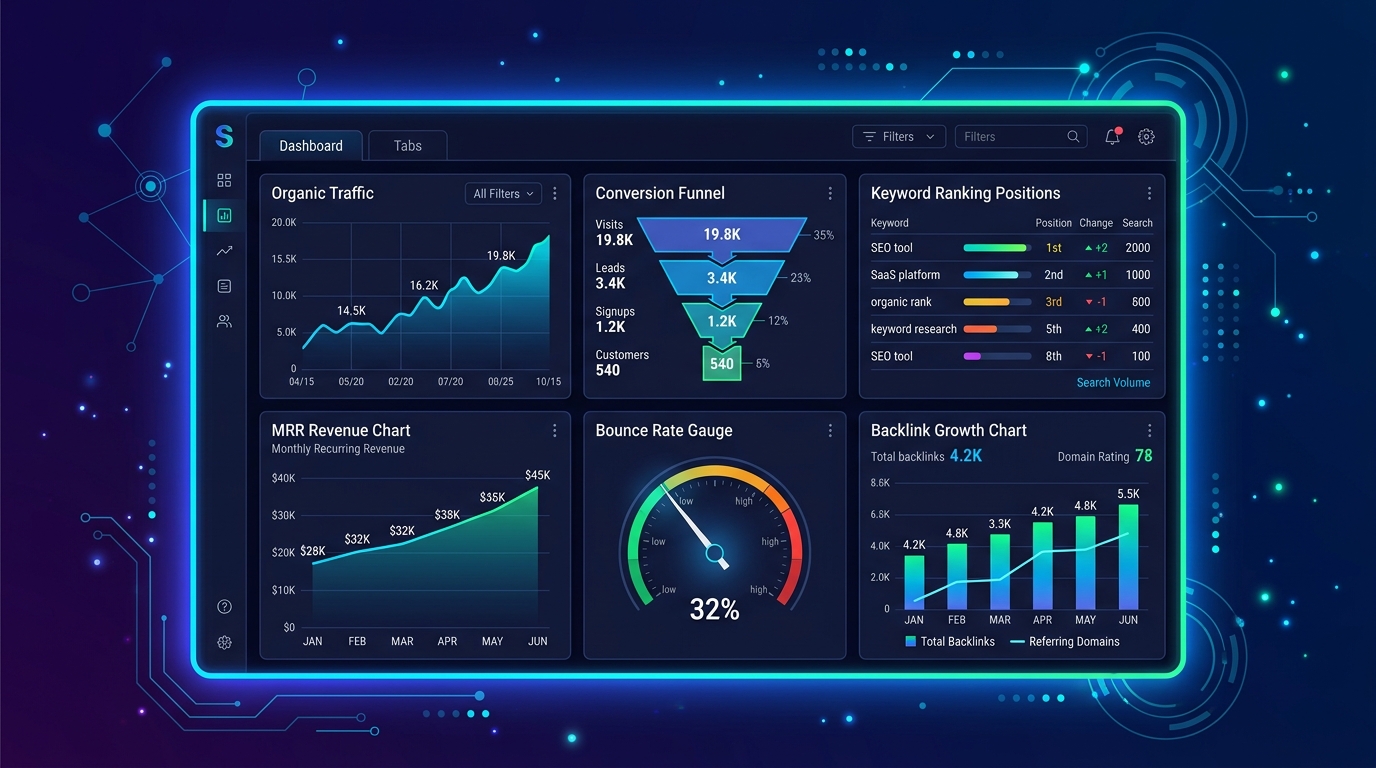
Tracking the right SaaS SEO metrics is the difference between blindly creating content and systematically driving Monthly Recurring Revenue (MRR). In 2026, ranking for high-volume keywords isn't enough; you need to connect your organic search efforts directly to product signups and pipeline revenue.
Why SaaS SEO Metrics Are Different from Standard SEO KPIs
When you are managing search engine optimization for an eCommerce store or a local business, the metrics you track are relatively straightforward. More traffic generally equals more sales or more foot traffic. However, SaaS SEO is an entirely different ballgame. SaaS SEO metrics require a deep understanding of long, complex B2B buyer journeys, recurring revenue models, and multi-touch attribution.
Standard SEO campaigns often focus heavily on vanity metrics like total organic sessions, keyword rankings, and domain authority. While these are useful indicators of visibility, they do not pay the bills. For a SaaS company, revenue attribution matters significantly more than raw traffic numbers. You could generate 100,000 monthly visitors from top-of-funnel (ToFU) informational blog posts, but if none of those visitors convert into paying users, your SEO campaign has failed from a business perspective.
In the SaaS world, we must focus on metrics like Monthly Recurring Revenue (MRR), sales pipeline velocity, and Customer Acquisition Cost (CAC). An effective SaaS SEO strategy guide emphasizes tracking how organic traffic interacts with your product. Does a specific blog post drive free trial signups? Does your feature page generate high-quality demo requests? These are the questions your SEO KPIs must answer.
Furthermore, SaaS companies often deal with long sales cycles. A user might discover your brand through an informational article, return weeks later to read a comparison post, and finally sign up after searching for a branded term. This makes tracking multi-touch attribution and understanding the entire user journey critical. In 2026, SaaS marketing leaders must look beyond Google Analytics and integrate their SEO data directly with their CRM to track the true ROI of organic search.
Traffic Metrics That Actually Matter
Not all traffic is created equal, especially in the SaaS industry. While looking at a graph of rising organic sessions is satisfying, it's essential to segment that traffic to understand its true value. Relying on aggregate traffic numbers can mask underlying issues or falsely inflate the perceived success of your campaigns.
First, you must monitor organic sessions, but you need to split this into non-branded vs. branded traffic. Branded traffic (people searching for your company name) indicates brand awareness and direct demand. Non-branded traffic (people searching for solutions to their problems) indicates the actual effectiveness of your SEO efforts in capturing net-new audiences. A healthy SaaS SEO campaign should show consistent growth in non-branded organic sessions.
Next, focus on organic new users. This metric tells you how many unique individuals are discovering your SaaS product for the very first time through search engines. It is a vital indicator of top-of-funnel growth. If your total sessions are high but new users are low, you might be relying too heavily on existing users returning to your site via search rather than acquiring fresh prospects.
You should also track page-level traffic trends. Which specific landing pages and blog posts are driving the most traffic? Are your high-converting Bottom-of-Funnel (BoFU) pages seeing traffic growth, or is all the growth coming from low-converting glossary terms? Analyzing traffic at the page level allows you to double down on what works and optimize what doesn't.
Finally, keep a close eye on the mobile vs. desktop breakdown. For many B2B SaaS companies, desktop traffic remains king because users are researching software solutions while at work. However, mobile traffic is increasingly important for initial discovery. Ensure your site delivers a flawless experience across all devices, as Google's mobile-first indexing dictates your rankings based on your mobile site.
Ranking & Visibility Metrics
Tracking keyword rankings is a fundamental aspect of any SEO campaign, but SaaS companies need a more nuanced approach. It's not just about how many keywords you rank for; it's about ranking for the right keywords at every stage of the buyer's journey.
You must track keyword positions with a clear distinction between Bottom-of-Funnel (BoFU) and Top-of-Funnel (ToFU) terms. BoFU keywords (e.g., "best CRM for real estate," "Mailchimp alternatives") have lower search volume but incredibly high conversion intent. ToFU keywords (e.g., "what is email marketing," "how to generate leads") drive higher volume but convert at lower rates. Monitoring these categories separately helps you balance your strategy and predict future pipeline growth. Using the best SEO tools for SaaS is essential for accurately tracking these segmented keyword lists.
Beyond traditional rankings, SERP feature occupancy is a critical visibility metric in 2026. Getting the number one blue link is great, but capturing Featured Snippets, appearing in People Also Ask (PAA) boxes, and securing Knowledge Panels can dramatically increase your click-through rates (CTR). With the rise of AI overviews, optimizing for these rich SERP features is mandatory for maintaining visibility.
Lastly, monitor your Domain Authority (DA) or Domain Rating (DR) progression. While DA/DR are third-party metrics and not used by Google, they serve as a helpful proxy for your website's overall link authority compared to your competitors. A steadily increasing DR indicates that your link-building and PR efforts are successfully building your site's reputation, making it easier to rank for competitive keywords over time.
Engagement & User Quality Metrics
Getting users to click on your search result is only half the battle. Once they arrive on your website, how do they behave? Engagement metrics reveal the quality of your organic traffic and the effectiveness of your content in satisfying user intent.
The first metric to analyze is bounce rate by landing page. A high bounce rate isn't inherently bad—if a user finds a quick answer on a glossary page and leaves, that's normal. However, a high bounce rate on a core feature page or a high-intent BoFU article indicates a serious mismatch between what the user expected and what your page delivered. You must investigate these pages to improve intent matching and user experience.
Average session duration and pages per session provide deeper insights into user engagement. For a SaaS company, you want users to explore your site. If someone lands on a blog post, you want them to click through to a product feature page, read a case study, and ultimately view your pricing page. Higher pages per session and longer session durations strongly correlate with higher conversion probabilities.
For your content marketing efforts, tracking scroll depth is invaluable. Are users actually reading your 2,000-word guides, or are they abandoning the page after the first paragraph? Scroll depth tracking (easily set up via Google Tag Manager) shows you exactly where users lose interest. If most users drop off at the 25% mark, you need to improve your hook, add visual elements, or restructure the content to make it more engaging and scannable.
Conversion Metrics: From Organic Traffic to Revenue
This is the most critical section for any SaaS marketing leader. If you cannot tie your organic traffic to revenue, securing budget for SEO will be an uphill battle. Conversion metrics bridge the gap between marketing outputs and business outcomes.
The primary conversion metrics to track are trial signups from organic search and demo requests from organic search. You must use robust attribution modeling to understand which organic touchpoints contributed to these conversions. Did the user convert on their first visit after reading a comparison post? Or did they visit your site five times via various informational articles before finally requesting a demo? Tracking both first-touch and last-touch attribution provides a complete picture.
However, generating signups is not enough. You must track the organic-to-paid conversion rate. Are the users acquired through SEO actually pulling out their credit cards? If you generate 500 free trials from organic search but only 2 of them become paying customers, you have a major problem with lead quality. It indicates that you might be ranking for keywords that attract the wrong target audience.
Similarly, monitor your free-to-paid upgrade rate specifically for organic cohorts. Compare this rate against users acquired through paid ads or outbound sales. Often, you will find that organic leads have a higher lifetime value (LTV) and better retention rates, which is a powerful data point to prove the long-term ROI of your SEO investments. Ultimately, every SaaS SEO report should highlight the pipeline value and MRR directly attributable to organic search efforts.
Technical Health Metrics
A technically sound website is the foundation of any successful SEO campaign. If search engines cannot crawl, render, and index your pages efficiently, all your content and link-building efforts will be wasted. Monitoring technical health metrics ensures your foundation remains solid.
Index coverage is a primary metric to monitor via Google Search Console. You need to know how many of your pages are successfully indexed and how many are excluded. More importantly, you must investigate the reasons for exclusion. Are important product pages blocked by a stray robots.txt rule? Are there hundreds of duplicate pages causing crawl bloat? Keeping a clean index is vital for SaaS sites with complex architectures. Review our technical SEO services to see how we handle enterprise-level indexing issues.
Track crawl errors diligently. 404 Not Found errors, 5xx Server errors, and redirect loops degrade the user experience and waste valuable crawl budget. Set up automated alerts to catch and resolve these errors promptly before they impact your rankings.
In 2026, Core Web Vitals scores and site speed are non-negotiable. Google uses Largest Contentful Paint (LCP), Interaction to Next Paint (INP), and Cumulative Layout Shift (CLS) as ranking signals. A slow, janky SaaS website not only hurts your rankings but severely damages your conversion rates. Users expect modern software companies to have lightning-fast websites. Regularly test your pages using PageSpeed Insights and ensure passing scores across the board.
Finally, monitor mobile usability errors. Even if the majority of your conversions happen on desktop, Google indexes the mobile version of your site. Any mobile usability issues, such as text being too small to read or clickable elements being too close together, can suppress your rankings across all devices. We strongly recommend performing a comprehensive SEO audit every quarter to catch technical regressions.
Backlink & Authority Metrics
Backlinks remain one of the strongest ranking factors in Google's algorithm. For a SaaS company to compete in highly lucrative niches, building a robust and authoritative backlink profile is essential. Tracking authority metrics helps you measure the success of your digital PR and outreach campaigns.
The most important metric here is referring domains growth. Total backlink count can be misleading, as a single site might link to you thousands of times in a footer. The number of unique referring domains provides a much more accurate picture of your site's authority. You want to see a steady, natural-looking increase in referring domains over time.
Track your backlink velocity—the rate at which you acquire new links. A sudden spike in backlinks followed by months of zero growth can look unnatural to search engines. Consistent, high-quality link acquisition is the goal. For proven methods, explore our advanced SaaS link building strategies.
As mentioned earlier, monitor your DR/DA progression. While not a Google metric, it helps benchmark your site against industry competitors. If your top competitor has a DR of 75 and you have a DR of 30, you know you need a significant investment in link building to close the gap.
Lastly, keep an eye on your toxic link ratio. Negative SEO attacks and spammy automated scrapers can point hundreds of low-quality links to your site. While Google is generally good at ignoring these, a massive influx of toxic links can sometimes trigger algorithmic penalties. Conduct regular backlink audits and use the disavow tool if you notice a dangerous spike in malicious links.
Content Performance Metrics
Content is the engine that drives SaaS SEO. However, simply publishing articles and hoping for the best is not a strategy. You must rigorously measure the performance of your content library to maximize its return on investment.
Measure traffic per blog post and categorize it by topic cluster. This helps you identify which content themes resonate most with your audience and search engines. If your cluster on "marketing automation" is driving 80% of your blog traffic, you know exactly where to allocate your content budget next quarter.
A critical metric to monitor is the content decay rate. Over time, previously high-performing articles will inevitably lose traffic as competitors publish newer, more comprehensive content. By tracking historical traffic trends per URL, you can identify pages that are decaying and prioritize them for content refreshing and updating. Maintaining existing rankings is often much cheaper and faster than ranking a brand-new article.
Perform regular keyword cannibalization checks. As your content library grows, you risk publishing multiple articles that target the same search intent. This confuses Google and splits your ranking power, resulting in neither page ranking well. Tracking your keyword-to-URL mappings ensures that every page has a distinct purpose.
Most importantly, calculate the content ROI per article. By combining cost data (writer fees, editing time) with attribution data (conversions generated by the article), you can determine which pieces of content are actually profitable. Adhering to a strict on-page SEO checklist ensures every article is optimized to perform and drive this ROI.
Building Your SaaS SEO Dashboard
Data is useless if it's scattered across a dozen different platforms. To effectively track your SaaS SEO metrics, you need to build a centralized, automated dashboard that provides a single source of truth for all stakeholders.
The ideal SaaS SEO dashboard combines data from several key tools. You need Google Search Console (GSC) for accurate click, impression, and ranking data directly from Google. Google Analytics 4 (GA4) is essential for tracking user behavior, engagement metrics, and goal completions. A premium SEO tool like Ahrefs or Semrush provides competitive intelligence, backlink data, and third-party keyword volume. Most importantly, you must integrate your CRM (like HubSpot or Salesforce) to track lead quality, pipeline value, and closed-won revenue.
Determine the right reporting frequency for your organization. Tactical metrics (like crawl errors or sudden ranking drops) should be monitored weekly by the SEO team. Strategic metrics (like organic pipeline growth and MRR attribution) should be reported monthly to the marketing leadership. Quarterly reviews should focus on big-picture trends, content ROI, and budget allocation for the upcoming months.
Finally, create tailored stakeholder reporting templates. The CEO does not care about your Core Web Vitals scores; they care about Customer Acquisition Cost (CAC) and revenue. Your VP of Marketing cares about MQLs, SQLs, and channel performance. The engineering team cares about technical errors. Customize your dashboards so that each stakeholder sees the exact metrics that matter to their specific goals.
Setting Realistic SEO Targets for SaaS
One of the biggest mistakes SaaS founders make is setting unrealistic expectations for SEO. Search engine optimization is a compounding, long-term investment, not a quick-fix lead generation tactic. Setting accurate targets ensures leadership remains aligned and the SEO team has the runway needed to execute.
In Months 1-3, your targets should be entirely focused on foundational outputs and technical fixes. KPIs should include resolving critical technical errors, publishing a set volume of high-quality content, optimizing existing core pages, and establishing baseline measurement. Do not expect massive traffic or revenue spikes in this phase.
During Months 3-6, you should start seeing leading indicators of success. Targets should focus on increasing impressions in Google Search Console, improving average keyword positions for target terms, and seeing initial growth in long-tail, top-of-funnel traffic. You may start seeing a trickle of organic conversions, but the primary goal is establishing visibility.
In Months 6-12 and beyond, your targets must shift to business outcomes. Now you are measuring the growth in non-branded organic traffic, the number of demo requests or free trials generated, and the actual pipeline revenue attributed to SEO. By month 12, SEO should be functioning as a predictable, scalable acquisition channel.
When setting OKRs (Objectives and Key Results) for organic growth, ensure they are achievable but ambitious. For example, an Objective might be "Establish SEO as a top 3 revenue channel." Key Results could include "Increase non-branded organic traffic by 40%," "Generate $50k in organic pipeline," and "Acquire 50 high-DR backlinks to core product pages."
Frequently Asked Questions
What is the most important SEO metric for SaaS companies?
For a SaaS company, the most important SEO metric is pipeline revenue generated from organic search. While traffic and keyword rankings are useful leading indicators, tracking Monthly Recurring Revenue (MRR) and demo requests attributed to organic traffic proves the true business value of your SEO campaign.
How long does it take to see SEO results for a SaaS business?
SaaS SEO is a long-term investment. Generally, you will see initial leading indicators (like increased impressions and keyword movement) within 3 to 6 months. However, significant, scalable growth in organic traffic and revenue typically requires 6 to 12 months of consistent content creation and authoritative link building.
How do you attribute revenue to SEO in a SaaS company?
Revenue attribution requires connecting your website analytics to your CRM. By using UTM parameters, hidden form fields, and first-touch/last-touch attribution models in platforms like HubSpot or Salesforce, you can trace a paying customer's journey back to their initial organic search interaction and the specific landing page they visited.